
What Is the Best Refrigerated Storage Container in China?
Choosing the best refrigerated storage container in China requires more than comparing prices or advertised temperature ranges. A reliable unit must protect products during loading, transport, storage, and power interruptions. In a busy warehouse, small details matter: a damaged door gasket, wet floor, weak insulation, or a poorly placed sensor can quickly create temperature variations.
Professor Judith Evans, a respected refrigeration researcher, has emphasized, “Temperature control must remain stable throughout the cold chain.” That principle is practical, not decorative. Buyers should examine cooling performance, insulation thickness, internal airflow, controller accuracy, data logging, and emergency alarm functions. A container holding frozen food may need stable conditions near -18°C, while fresh produce often requires a different range. The correct choice depends on the cargo, not only the container label.
Chinese manufacturers offer many options, including modified shipping containers, portable cold rooms, and specialized refrigerated units. Some provide excellent customization and responsive maintenance. Others may appear attractive but offer limited technical documentation or inconsistent after-sales support. This is where careful evaluation becomes essential. Ask for test records, compressor specifications, energy-use data, warranty terms, and service coverage in your region.
A minor weakness may remain.
Even a well-built refrigerated storage container can fail when users overload it or block the air outlets. That uncomfortable fact deserves attention. The strongest purchase decision combines verified performance, practical operating experience, and dependable local support. This guide compares the main options in China and explains which features deserve real investment.
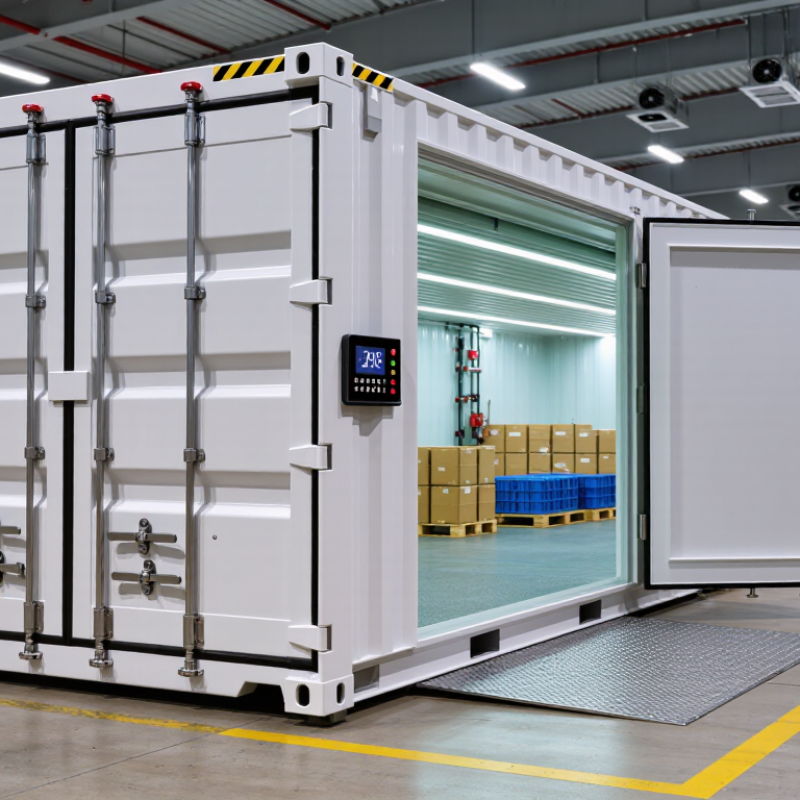
Types of Refrigerated Storage Containers Available in China
China offers several refrigerated storage container types for farms, factories, ports, and food distributors. The right choice depends on temperature range, storage time, and delivery distance. Insulated passive containers use thick panels and cooling packs. They suit short deliveries of vegetables, dairy products, and prepared food. They need no external power, but their cooling time is limited.
Active refrigerated containers use compressors and electric controls. They provide steadier temperatures for seafood, meat, and long-distance distribution. Standard units often support chilled storage, while low-temperature models handle frozen goods. Some facilities also use modular cold rooms, which provide larger capacity and easier internal movement. Portable containers are useful at temporary sites, although uneven ground can affect door sealing.
Power changes everything. A reliable electrical connection is essential for active models. During site checks, operators should inspect insulation joints, floor strength, drain design, and alarm functions. A temperature data logger adds useful evidence when delivery quality is questioned. Small doors matter. Frequent opening can quickly raise the internal temperature, even when the compressor works normally.
I would not select a container from capacity alone. A large model may waste energy when half empty. A smaller unit may create loading pressure and poor air circulation. Humidity also deserves attention, especially with leafy produce. One practical weakness remains common: users sometimes trust displayed temperatures without checking sensor position. The screen may show 2°C while warm air gathers near the door. Regular calibration and simple loading discipline can prevent that mistake.
What Is the Best Refrigerated Storage Container in China? - Types of Refrigerated Storage Containers Available in China
| Container Type | Typical Temperature Range | Typical Capacity | Main Power Requirement | Typical Applications | Key Advantages | Important Limitations | Best Choice When |
|---|---|---|---|---|---|---|---|
| Insulated Cold Box | Usually 2–8°C with ice packs or phase-change materials; some models support frozen goods below 0°C | Approximately 10–150 L | No continuous power; optional powered cooling units are available | Short-distance delivery, food samples, medicines, vaccines, and laboratory materials | Lightweight, portable, low operating cost, and easy to load | Limited holding time and temperature stability; performance depends on preconditioning and ambient temperature | The shipment is small and the delivery period is relatively short |
| Refrigerated Delivery Box | Commonly 2–8°C or 15–25°C, depending on the cooling system and application | Approximately 20–500 L | Vehicle power, battery power, or mains electricity | Last-mile food distribution, medical logistics, catering, and retail delivery | Suitable for frequent deliveries and better temperature control than passive boxes | Requires charging, maintenance, and adequate ventilation around the cooling unit | Goods must be delivered repeatedly by vehicle within a local or regional route |
| Walk-In Cold Room | Usually 0–10°C for chilled storage; approximately −18 to −25°C for frozen storage | Approximately 5–100 m³ or more, depending on the modular design | Single-phase or three-phase mains electricity | Restaurants, supermarkets, farms, food processors, wholesalers, and distribution centers | Large usable volume, adjustable layout, and continuous temperature control | Requires installation space, electrical capacity, drainage, and regular servicing | Storage is stationary and the business needs high inventory capacity |
| Refrigerated Shipping Container | Typically about −30 to +30°C, depending on the refrigeration unit and cargo requirements | Common external lengths are 6.1 m or 12.2 m; internal volume is often about 28–76 m³ | Three-phase electricity is commonly required; exact voltage and frequency vary by equipment | Port logistics, export shipments, bulk food storage, seafood, meat, fruit, and pharmaceuticals | High capacity, strong structure, and suitability for multimodal transport | High purchase and operating costs; needs lifting equipment, level placement, and reliable power | Large-volume cargo must be stored or transported over long distances |
| Mobile Refrigerated Container | Commonly 0–8°C for chilled products or −18–25°C for frozen products | Approximately 10–40 m³ for compact modular units | Mains electricity; some units can connect to a generator or vehicle power system | Temporary storage, events, construction sites, harvest seasons, emergency response, and regional distribution | Relocatable, faster to deploy than a permanent cold room, and useful for seasonal demand | Transport and positioning may require special equipment; operating costs increase in hot weather | Cold storage must be moved or installed temporarily at different locations |
| Pharmaceutical Passive Container | Often designed for 2–8°C, 15–25°C, or frozen ranges using qualified thermal packs | Approximately 5–150 L of usable payload space | Usually no continuous power; electronic temperature monitoring is commonly used | Vaccines, biologics, clinical samples, diagnostic materials, and temperature-sensitive medicines | Validated thermal performance, tamper-resistant design options, and easy documentation | Higher purchase cost and strict requirements for pack placement, conditioning, and handling procedures | Temperature compliance and shipment traceability are more important than maximum capacity |
| Blast Freezer Container | Typically below −18°C for frozen storage; blast-freezing processes may use much lower air temperatures | Approximately 10–60 m³, depending on the design and cooling capacity | High-capacity mains electricity, commonly three-phase | Seafood, meat, prepared foods, frozen fruit, and processing facilities | Rapid product freezing can help preserve texture, quality, and shelf life | High energy demand; loading patterns, airflow, product thickness, and moisture affect performance | Products must be frozen quickly before long-term frozen storage or transport |
Note: Actual temperature range, capacity, energy consumption, and holding time vary by insulation thickness, refrigeration system, ambient conditions, loading density, door-opening frequency, and local electrical standards. The most suitable container should be selected according to cargo type, required temperature, storage duration, transport distance, available power, and regulatory requirements.
Related Posts
-
Top 10 Benefits of Using a 20ft Refrigerated Container for Your Business
-
How to Choose the Right 20ft Refrigerated Container for Your Needs?
-

Best 20ft Refrigerated Container Options for Global Buyers?
-
China Best Cold Storage Container Manufacturers?
-
China Top Refrigerated Storage Container Solutions for Your Business Needs?
-

What Is a 40 ft Storage Container?